

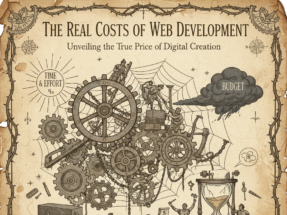
The Real Costs of Web Development: A Complete Breakdown
When budding entrepreneurs or established businesses decide they need a website, one of the first questions they ask is: "What will this actually cost?" The answer isn't simple, because web development encompasses everything from initial planning to ongoing maintenance. Let's break down the entire process and associated costs so you can budget appropriately for your project.
Understanding the Web Development Process
Before diving into costs, it's important to understand what you're actually paying for. Web development isn't just coding—it's a multi-phase process that transforms an idea into a functioning online presence.
The journey typically begins with discovery and planning, where developers work with you to understand your business goals, target audience, and technical requirements. This phase sets the foundation for everything that follows and can take anywhere from a few days to several weeks depending on project complexity.
Next comes design, where the visual identity of your site takes shape. Designers create mockups and prototypes that show how your site will look and feel. This is followed by the development phase, where those designs become reality through code. Developers build the front-end interface that users interact with and the back-end systems that power functionality like databases, user accounts, and content management.
Testing and quality assurance come next, ensuring everything works properly across different browsers and devices. Finally, there's the launch and the often-overlooked ongoing maintenance that keeps your site secure, updated, and running smoothly.
Breaking Down the Costs
Basic Informational Websites
For a simple brochure-style website with five to ten pages, you're typically looking at $2,000 to $10,000. These sites usually include basic information about your business, services, contact forms, and perhaps a blog. At the lower end, you might be working with a freelancer using a template-based approach. At the higher end, you'll get more custom design work and potentially some basic custom features.
Small Business Websites
When you need something more robust—perhaps with e-commerce capabilities, member login areas, or integration with third-party services—costs rise to the $10,000 to $50,000 range. This tier includes custom design work, more sophisticated functionality, and often a content management system that lets you update content without touching code.
Enterprise and Complex Applications
Large-scale websites and web applications can run from $50,000 to several hundred thousand dollars or more. These projects involve custom development, complex database architecture, third-party integrations, advanced security features, and often months of development time. Think customer portals, internal business applications, or sophisticated e-commerce platforms with custom workflows.
The Hidden Costs: Web Hosting
One cost that catches many people off guard is web hosting—the service that makes your website accessible on the internet. Think of it as renting space for your website to live. Hosting is an ongoing expense, not a one-time cost, and the price varies significantly based on your needs.
Shared Hosting is the most economical option, running $3 to $15 per month. Your website shares server resources with other sites, which keeps costs down but can mean slower performance during traffic spikes. This works well for small business sites with modest traffic.
Virtual Private Server (VPS) hosting offers more resources and control for $20 to $100 per month. You still share a physical server, but you get dedicated resources allocated specifically to your site. This is a good middle ground for growing businesses.
Dedicated hosting, where you rent an entire server just for your site, runs $80 to $500+ per month. This gives you maximum performance and control but requires more technical knowledge to manage effectively.
Cloud hosting has become increasingly popular, with costs that scale based on usage. Services like Amazon Web Services, Google Cloud, or Microsoft Azure might cost $10 to several thousand dollars monthly depending on your traffic and resource needs. The advantage is flexibility—you pay for what you use and can easily scale up or down.
Don't forget about related hosting costs like SSL certificates for security (often $0 to $200 annually, though many hosts include them free now), domain registration ($10 to $50 per year), and email hosting if you want professional addresses using your domain ($5 to $25 per user per month).
Ongoing Maintenance Costs
Your website isn't a "set it and forget it" proposition. Ongoing maintenance typically runs 15% to 20% of the initial development cost annually. This covers security updates, content updates, bug fixes, and ensuring compatibility with evolving browser standards.
Many development agencies offer maintenance retainers ranging from $500 to $5,000+ monthly depending on the complexity of your site and how much support you need. Some businesses handle basic updates in-house but keep developers on retainer for more complex changes and troubleshooting.
Ways to Reduce Costs
If your budget is tight, consider a phased approach. Launch with essential features first, then add functionality as your business grows and generates revenue. Website builders like Squarespace, Wix, or WordPress.com can get you started for $10 to $50 monthly, though you'll sacrifice customization and scalability.
Using open-source platforms like WordPress, Drupal, or Joomla can also reduce costs since the core software is free. You'll still pay for design, customization, and hosting, but you avoid licensing fees for proprietary systems.
Making the Investment Worth It
Web development costs money because you're paying for expertise, time, and tools that deliver a professional online presence. A well-built website generates leads, builds credibility, and can operate as a sales tool 24/7. When you frame it as an investment rather than an expense, the costs make more sense.
The key is being clear about your goals and budget from the start. Whether you're spending $3,000 or $300,000, make sure you understand what you're getting, what ongoing costs you'll face, and how the site will serve your business objectives. The cheapest option isn't always the best value, and the most expensive isn't always necessary. Find the approach that matches your needs, resources, and growth trajectory.